
The Butterfly That Is Blue With No Blue Pigment
Crush the wing of a brilliant-blue Morpho butterfly and the blue vanishes — the powder that is left is brown. There is no blue pigment anywhere in it. The color is not a dye at all; it is structure — a stack of transparent nanoscale ridges that reflects blue light and cancels the rest by interference, the same physics that colors a soap bubble or an oil slick. It is the most vivid color in nature and it is made of clear material and empty space. We rebuilt the trick in Ansys Lumerical FDTD: a periodic chitin-and-air multilayer, solved for the light it bounces back, turned into the exact color a person would see — and then tilted, to watch the blue shift.
Color without pigment
A pigment makes color by absorbing: a red apple soaks up every color but red. Structural color does the opposite — it absorbs nothing and instead uses interference to reflect one band of wavelengths and let the rest pass. Stack up thin transparent layers whose thickness is a fraction of the wavelength of light, and the reflections from each interface line up in phase for one color (they add) and out of phase for the others (they cancel). Choose the layer thickness right and the stack becomes a mirror for exactly one color. In a Morpho wing the layers are ridges of chitin (the clear material of insect shells, refractive index ~1.56) separated by air, tuned so the reflected band lands in the blue.
What FDTD actually computes
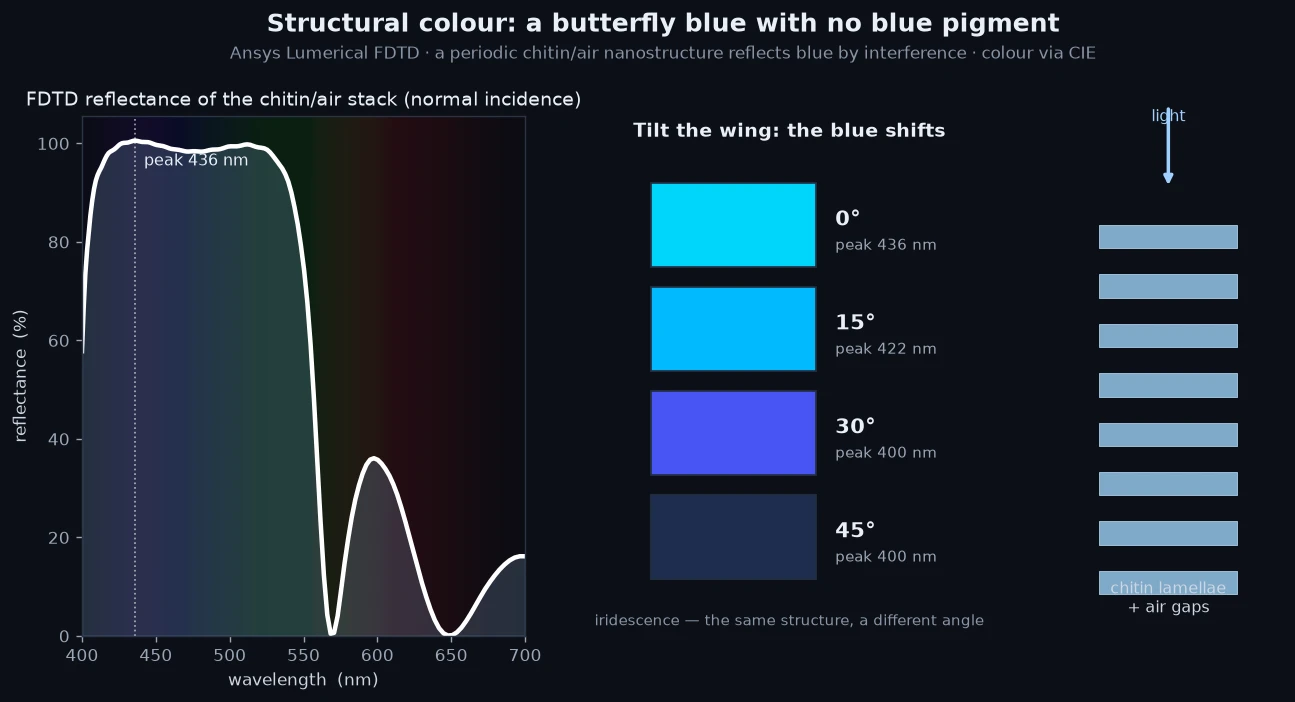
We built that stack in Lumerical FDTD — eight chitin lamellae with air gaps — and sent in a broadband pulse of light containing every visible color at once. FDTD marches Maxwell's equations forward in time on a grid, letting the wave reflect and interfere through the whole structure, and a monitor records how much of each wavelength comes back. That is the curve on the left: a clean reflectance band peaking around 436 nm — blue — while red and green pass straight through. Feed that reflectance spectrum through the same CIE color pipeline the human eye uses, and it comes out this blue. No pigment anywhere in the calculation — only clear chitin, air, and interference.
Tilt it: the color moves
Here is the tell-tale of structural color, the thing a pigment can never do. Tilt the wing and the blue shifts — toward violet, then toward the ultraviolet you can't see. That is iridescence: at a steeper angle the light travels a shorter effective path between layers, so the interference favors a shorter wavelength. Drag the viewing angle below and watch the swatch move. Same structure, different angle, different color — over our sweep the reflected peak walks about 36 nm toward the blue.
Why an engineer cares about a butterfly
Structural color is not just pretty — it is a manufacturing strategy. Because the color comes from geometry, not chemistry, it never fades, needs no dye, and can be tuned by changing a thickness. Engineers copy it deliberately: anti-counterfeiting holograms and banknote inks, structural-color paints and displays that never bleach, low-glare anti-reflection coatings (the same interference run in reverse), the dielectric mirrors inside every laser, and the color filters on your camera's sensor. Designing any of them means predicting how a nanostructure steers light — wavelength by wavelength, angle by angle — which is exactly what FDTD does. The butterfly is just the friendliest possible photonic device.
Designing a photonic structure — a color filter, a metasurface, an AR waveguide, a sensor coating, a laser mirror — and need to know exactly what light it reflects, transmits, and steers? The same Ansys Lumerical FDTD workflow behind this butterfly — build the nanostructure, send in the light, read the spectrum — is how photonics gets designed before a single wafer is etched. That's innovation through insight.