
Will Chip Survive the Fall? The Physics of Dropping a Minifigure
Everyone has dropped one. You knock a minifigure off the desk, it clatters onto the floor, and — usually — the head pops off and rolls under the couch. A community member asked the small, secretly-deep version of that everyday moment: how fast does a minifigure actually fall, and does it survive the landing? So we gave our test subject a name — meet Chip, minifigure-style crash-test pilot — and asked three questions a drop-test engineer would ask of any product: how fast does he hit, how does he fall, and when he lands, does the plastic break or does he come apart? The answers came from a tumbling-flight simulation and an Ansys LS-DYNA impact matrix, and the verdict is unforgettable.
Meet Chip
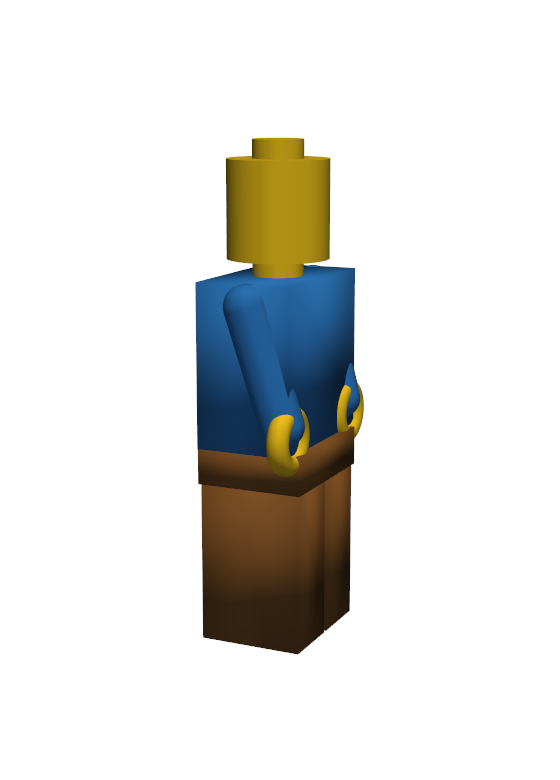
The minifigure turned up in 1978 and has quietly become one of the most-produced little people on Earth — billions of them, a genuine design icon having a real cultural moment. That ubiquity is exactly what makes it the perfect crash-test subject: everyone has held one, everyone has dropped one, and almost nobody knows what actually happens on the way down. Chip is our stand-in — a self-authored, generic minifigure-style figure built to publicly-documented proportions (about 48 mm tall, 4.0 grams of ABS), not a copy of anyone's ornamental design. Crucially for the physics, he is not one molded lump: he is seven parts — head, torso, hips, two legs, two arms — held together by the famous snap-fit clutch power. That means, when a fall gets violent, he has two completely different ways to fail: the tough ABS could crack, or the snap-fits could let go. Only a model that actually has those joints can tell the two apart.
Question one: how does he fall?
Before “how fast” comes a question people rarely ask: what attitude does he fall in? A skydiver spreads into a stable, flat belly-flop and holds it. Does Chip? To find out we ran a 6-DOF rigid-body simulation — his real inertia tensor from the meshed geometry, gravity, and a quasi-steady aerodynamic model — and dropped him 220 times from 22 meters, each with a random starting orientation and a flick of spin, like knocking him off a ledge.
The result is the opposite of a skydiver: Chip essentially never lands flat.
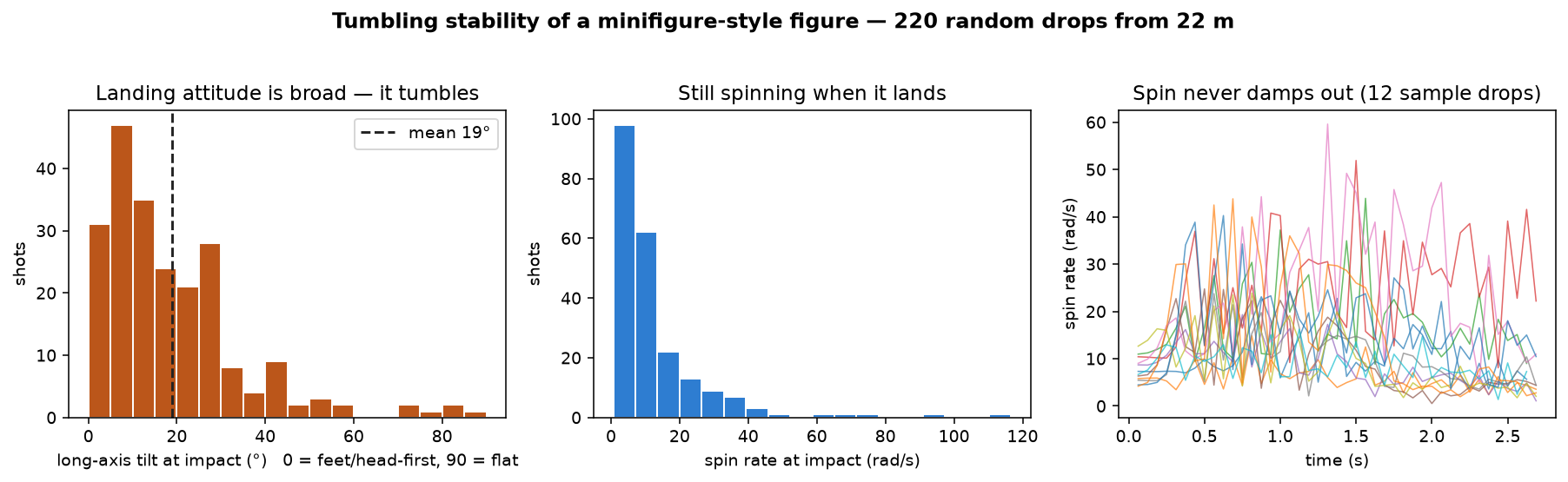
He comes in end-first (62%) or still tumbling (33%), hardly ever in the flat pose — his little aerodynamic restoring torque simply isn't enough to stabilize a flat descent, so he tumbles and rocks the whole way down. Two more things fall out of the same run. First, his impact speed is a remarkably steady ~41 km/h (11.5 m/s), within a whisker across all 220 drops — because tumbling averages his drag area, the terminal speed converges no matter how he starts. Second, a third of the time he is still spinning at impact. The practical upshot: the landing attitude is a coin toss, and the hardest, pointiest parts — the head and the feet — are the ones that meet the ground. That is why we don't test one pose; we test a spread.
Question two: does he survive? The impact matrix
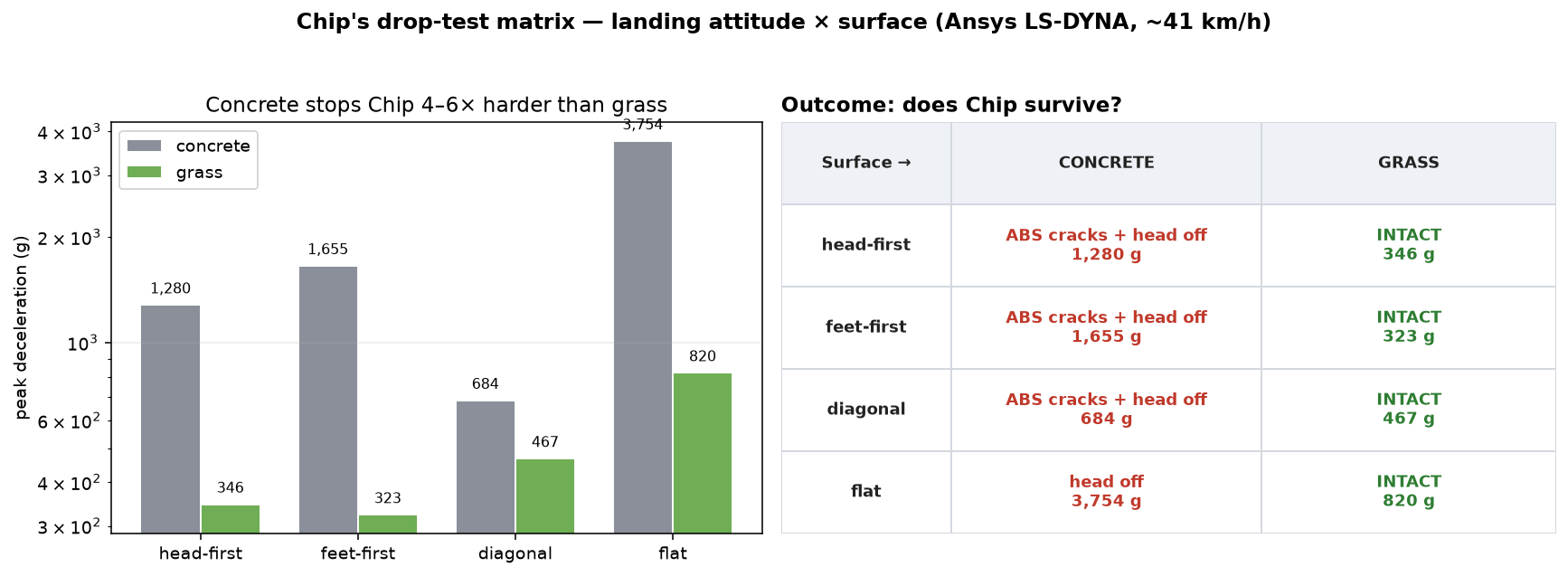
Now the real solver work. We took four representative landing attitudes — head-first, feet-first, diagonal, and (for contrast) flat — and dropped Chip at 41 km/h onto two surfaces in Ansys LS-DYNA: concrete and grass. Each of his seven parts is its own block of solid elements; where two parts meet, a tiebreak contact holds them together until the combined pull-and-shear exceeds the real snap-fit clutch strength (~0.8–1.4 MPa), then releases and lets the part fly. The ABS has a 42 MPa yield and a fracture strain, so an element that is strained past its limit simply fails and deletes — a chip breaking off. Concrete is modeled as a deformable 30 GPa slab (real concrete stiffness, not an infinitely-rigid wall — which matters, see the scope note); grass is a crushable-foam pad that squashes the way sod does.
Concrete: Chip loses his head — every time
On concrete, the deceleration runs from ~700 g to ~3,800 g depending on how he lands, and the outcome is consistent and brutal: the head snaps off in all four attitudes. The head-torso snap-fit is the smallest joint and sits at the end of the whip, so the sudden stop always overloads it — the head separates by 35–68 mm and flies. On top of that, whatever hits first chips: land head-first and the head crown fractures (elements reach the ABS failure strain and delete); land feet-first or diagonal and the legs fracture. The one exception to chipping is the flat slap — it spreads the load over his whole side, so nothing cracks, but it stops him the hardest of all (3,750 g) and still throws the head off. In every concrete case, Chip both breaks and comes apart.
Grass: he walks away
Swap concrete for the foam pad and everything changes, for one reason: time. Instead of stopping in a millimeter against something stiff, Chip sinks a little into the sod and stops over a longer distance — so the peak deceleration drops 4–6×, to a mere 320–820 g. That is now well within what the snap-fits can hold: no joint releases, nothing fractures, the head stays on. In all four attitudes he lands, bounces, and is fully intact. Same figure, same 41 km/h — the surface, not the pose, decides whether he shatters or shrugs it off.
Why an engineer cares about dropping a toy
Chip is a toy, but the questions underneath him are the daily bread of mechanical design. How does a dropped product actually land — does it settle into a face, or tumble to a corner? (Ask anyone who has watched a phone flip to land on its glass.) And when it hits, what fails first — the material, or the joints? A phone that survives the fall but whose battery door flies off; a housing that never cracks but whose snap clips let go; a connector that unseats on impact. Predicting that means exactly what we did with Chip: understand the tumbling attitude so you test the orientations that really happen, then model the parts and the bonds between them at impact speed, with a real release criterion, so you can separate “the material broke” from “the assembly came apart.”
Have a product that has to survive a drop — and you need to know how it lands and whether it's the plastic or the joints that give first? The same Ansys workflow behind Chip — a tumbling-flight model to find the real impact attitudes, then an LS-DYNA multi-body drop with true contact and release physics — is how simulation answers “does it break, does it come apart, and what do we change so it doesn't.” That's innovation through insight.