
How Hard Can You Slam a Car Door Before the Window Shatters?
Everyone has done it: closed a car door a little too hard, heard the whole frame boom, and winced — is the window about to go? Someone in the Ideas Lab wanted a real number. So we built the side window in Ansys LS-DYNA, arrested the door frame the way a latch does, and let the glass keep going. Then we turned the slam up until it broke.
The physics: the glass keeps going when the door stops
A door swings on a vertical hinge, and at the instant the latch catches, the door’s velocity is pointed straight through the window plane. The latch arrests the frame in a millisecond or two — but the pane of glass held inside it still carries all its momentum. For a brief moment the frame has stopped and the middle of the glass has not, so the pane bends outward about its supported edges. Bending a plate puts one face into tension, and glass is brittle: it fails from tensile surface stress. If that stress reaches the glass’s fracture strength, a surface flaw runs and the pane lets go.
That is the whole mechanism, and it is clean to model: give the whole assembly the closing speed, then decelerate the supports to a stop over the latch time while the glass is free to overshoot. The peak tensile stress lands right where you’d expect — along the bottom clamp line and the lower corners.
Inside the model
The window is a tempered pane, 450 × 400 mm and 3.2 mm thick, meshed with about 7,200 fully-integrated shell elements (ELFORM 16, five integration points through the thickness so the bending surface stress is resolved). Glass is a linear-elastic solid (E = 71 GPa, ν = 0.22) with a maximum-principal-stress erosion criterion — when a surface fiber reaches the fracture stress, that element is deleted, which is how the crack and the dicing propagate. The slam itself is a prescribed velocity ramp: everything starts at the closing speed, then the edge supports are brought to rest over a ~1.5 ms latch time. We ran it two ways — a realistic mount (a soft rubber run-channel around three edges, gripped at the bottom by the regulator) and an all-edges-rigidly-clamped bound — so the answer doesn’t hinge on one modeling choice.
Is it right? Tempered vs. ordinary glass — the number that matters
The whole answer turns on one material number: the glass’s fracture stress. Ordinary annealed glass fails at roughly 40–80 MPa — it’s surface-flaw limited. Automotive side glass is tempered: the surface is locked into about 100 MPa of residual compression, so an applied tension has to first cancel that compression and only then reach the intrinsic strength. That puts tempered fracture near 150 MPa — and it is exactly why side windows dice into harmless cubes instead of shattering into shards. We ran the speed sweep against both strengths:
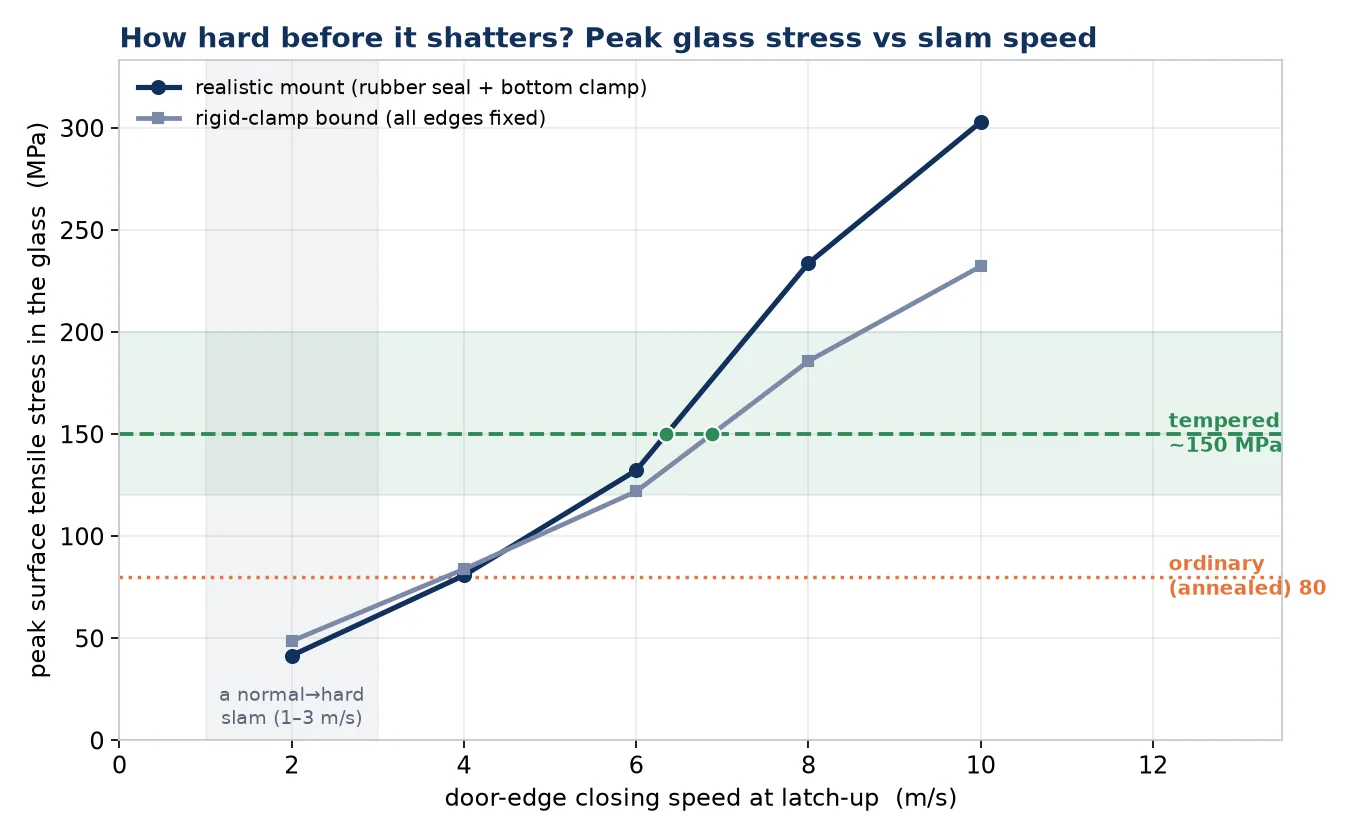
So if your side window were ordinary annealed glass, a genuinely violent ~4 m/s slam could crack it. Because it is tempered, you would have to close the door at ~15 mph — which no human arm can do. The control here isn’t a single simulation; it’s the contrast between the two strengths, and the fact that two very different mounting assumptions give the same threshold within a few percent.
The real-world connection
This is the same reason a spring-loaded emergency “window punch” shatters a car window instantly while a hard slam does nothing: the punch is a sharp point load that spikes the local stress past 150 MPa in one tiny spot, while a slam spreads its energy across the whole pane and never gets close. Distributed bending is simply the wrong way to break tempered glass — which, for a side window whose job is to survive years of slams, is precisely the point. And when tempered glass does finally go, it goes the safe way: the stored surface energy releases into thousands of small cubes, the failure mode you saw in the hero clip.
Need to know whether a part survives an impact, a drop, or a slam — with a real fracture threshold instead of a guess? The same Ansys explicit-dynamics workflow — a resolved shell model, a physically-grounded failure stress, and the honest sensitivity bracket — is the kind of workflow that helps teams qualify glazing, housings, brittle components and impact events. Innovation through insight.