
Could a Bridge Survive If Every Person Jumped at Once?
It's the classic playground dare, scaled up: pack a bridge with people and have everyone jump at exactly the same moment. An anonymous community member asked us to settle it properly — compare a crowd standing still, jumping randomly, and jumping in perfect sync, with real transient structural dynamics. So we designed a bridge, filled it with 504 people, and let Ansys Mechanical run the experiment no ethics board would ever approve. The answer has a twist: the bridge survives — but not because it's strong enough. It survives because physics fires the crowd first.
The bridge — and why 2.48 Hz is the whole story
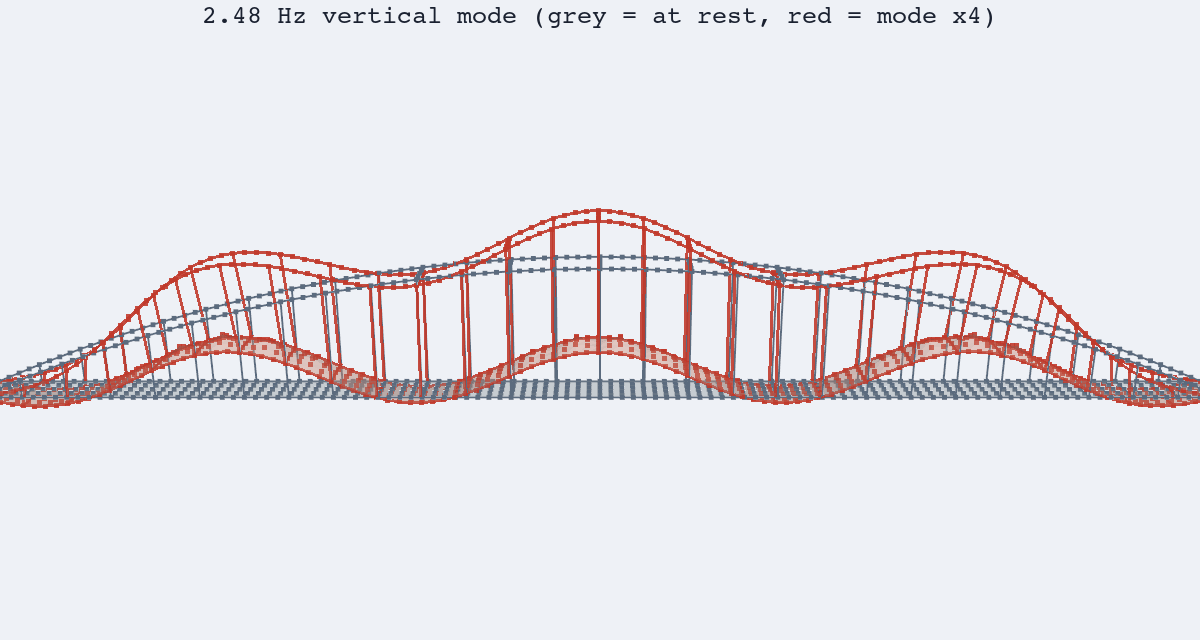
Per the engineering steering ("build a nice bridge… simple enough but recognizable"), we designed a classic tied-arch bowstring footbridge: 84 m span, twin CHS steel arches, a 3 m deck hung from rod hangers — 53 metric tons of S355 steel, the silhouette of every nice park bridge you've ever crossed. Its first crowd-pumpable vertical mode came out at 2.48 Hz with 23 metric tons of modal mass.
That number is the crux. Humans jump comfortably at 1.8–3.4 Hz — and slender modern footbridges have first vertical modes at 1.5–3 Hz. The forcing and the structure overlap, which is why design guides (Sétra, HiVoSS) treat this band as the danger zone, and why this question is not actually silly at all.
Three experiments, one crowd
We loaded the deck with 504 people at festival density (2 per m², 75 kg each): 37.8 metric tons of crowd — 71% of the bridge's own mass. Each person pushes on the deck with the measured ground-reaction force of human jumping (the Bachmann model: your feet hit with up to ~1.8× your body weight at the jump rate, plus harmonics). Then three 40-second transient solves:
Standing still: the crowd sags the deck a static 43 mm. A non-event — bridges carry weight for a living.
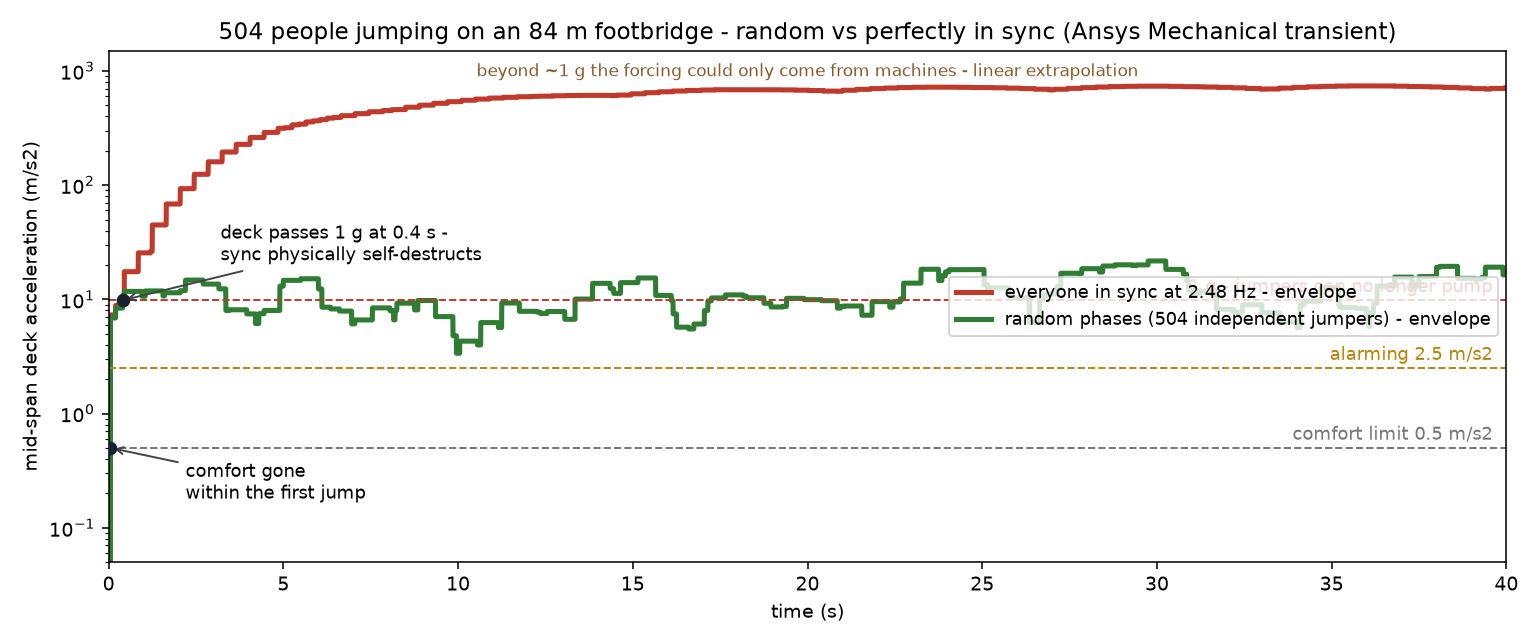
Jumping at random: every one of the 504 jumpers gets their own rhythm and phase. The pushes mostly cancel — but not entirely: the deck bounces about ±4 cm at up to ~2 g. Structurally the steel barely notices (stresses far below yield), but as a place to stand it is somewhere between a trampoline and a fairground ride. Codes would already fail this bridge on comfort.
Jumping in perfect sync at 2.48 Hz: resonance. Every landing arrives exactly when the deck is already moving down, and the amplitude compounds jump after jump:
| Time | What happens |
|---|---|
| 0.05 s | Within the first jump, the deck blows through the 0.5 m/s² comfort limit and the 2.5 m/s² "alarming" threshold |
| 0.40 s | The deck's acceleration passes 1 g — while the crowd is still below one-sixth of full effort. The floor now falls away faster than the jumpers do; nobody can stay in contact to keep pumping. The first hangers momentarily go slack. Steel stress at this instant: 9% of yield |
| beyond | Only a machine could keep forcing. The linear model, run on anyway: ±3.0 m of mid-span motion, 75 g, arch stress 12× yield — unambiguous collapse |
Checking the physics
Resonance has a beautiful hand-check: at steady state, response amplitude equals modal force divided by twice the damping. Feeding the actual 2.48 Hz mode shape (mass-normalized, straight from the modal solution) and the crowd's first-harmonic force into that single-degree-of-freedom formula predicts a steady deck acceleration of 735 m/s². The full 8,000-step transient solve delivered 737 m/s² — a ratio of 1.00. Two independent routes, same answer; the model is doing real physics.
Why engineers care about jumping crowds
This exact physics has closed real bridges. Broughton (1831) and Angers (1850) collapsed under marching soldiers; London's Millennium Bridge (2000) was shut two days after opening when pedestrians unconsciously synchronized laterally — the walking cousin of our jumping case. Modern footbridge guides exist precisely because of it: they flag natural frequencies in the 1.7–2.5 Hz band (ours: 2.48), cap accelerations for comfort (0.5 m/s² — our synced crowd exceeds it 1,500-fold in extrapolation), and push designers toward tuned mass dampers, stiffer decks, or frequencies outside the human band. The same transient-dynamics workflow answers the stadium version (grandstands under bouncing fans), the factory version (machinery near structural modes), and the seismic version — anywhere periodic forcing meets a natural frequency with people attached.
Have a structure that lives near a forcing frequency — footfall, machinery, wind, waves — and need to know whether it rides it out, needs dampers, or needs a redesign? The same Ansys Mechanical workflow behind this study — modal analysis to find the modes, transient dynamics with real forcing to find the response, validated against theory — is how simulation answers "will it shake, how much, and what do we change." That's innovation through insight.